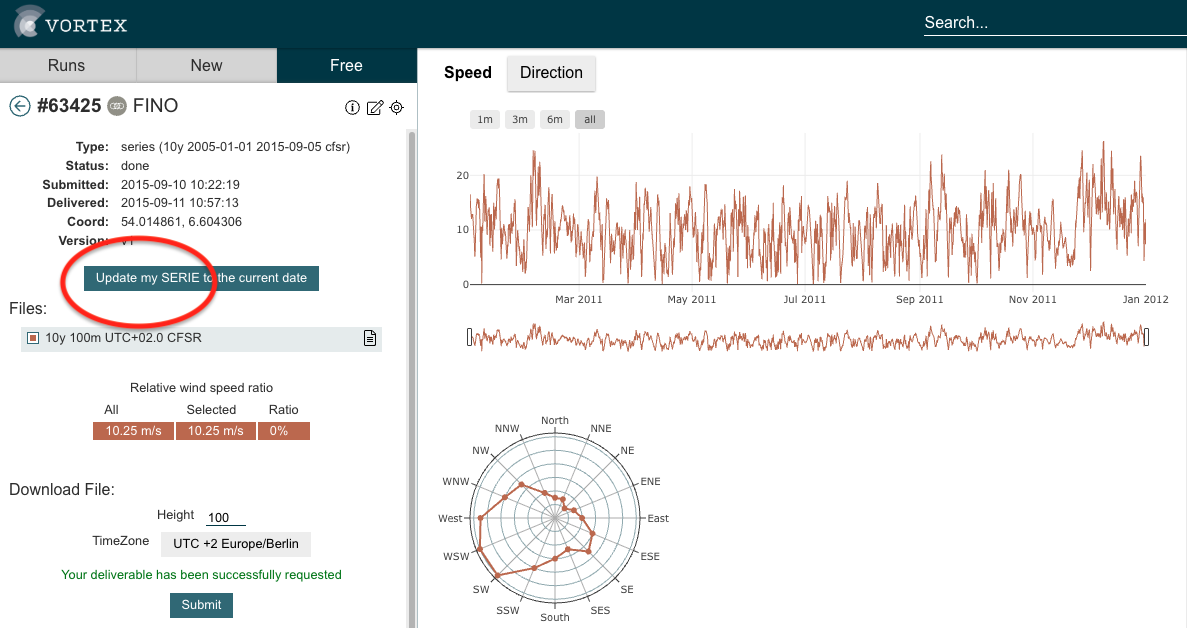
 Vortex Time Series Updates
One of the most common questions from Vortex users is how often time series can be updated and why different datasets become available at different times. Vortex generates time series using three global reanalysis…
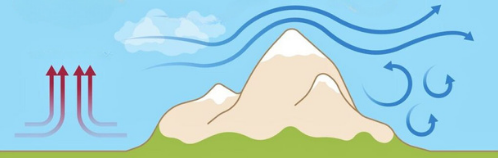 Stability Variables in Vortex Time Series
Atmospheric stability describes the tendency of air parcels to move vertically in the atmosphere. It influences wind shear, turbulence intensity, momentum mixing, and ultimately wind turbine performance. Unstable…
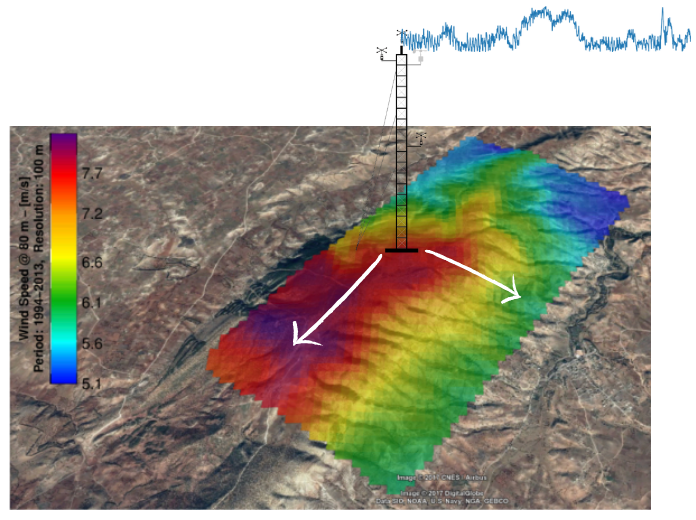 Local measurements and models, The Perfect Match
Modern wind resource models are more powerful than ever. Today, developers can access decades of atmospheric reanalysis data, high-resolution terrain models , and sophisticated numerical weather simulations covering…
 Vortex Icing
Wind farms in cold climates face a unique challenge: icing . When temperatures drop below freezing, moisture in the air can freeze onto turbine blades, altering their shape and weight. This reduces aerodynamic…
 The Wind Farm Timeline
When you drive past a row of turbines on the horizon, it’s easy to forget how much work goes into getting them there. A wind farm isn’t just a set of machines dropped into a field, it’s the result of years of planning,…
 ERA6 Reanalysis. WRF simulations
As explained in previous posts ( ERA6 Reanalysis. Prologue and ERA6 reanalysis Key Improvements , the new reanalysis ERA6 is expected to be released by the end of 2026. So far, the European Center for Medium-Range…
 Additional Datasets
At Vortex we use WRF model to produce high-resolution wind estimations. The three atmopheric reanalysis (ERA5 from ECMWF, MERRA2 from NASA and CFSR from NCEP) provides meteorological variables as wind horizontal…
 Comparison of ERA5 and MERRA2 reanalysis
This study presents a global comparative analysis of wind speed data from the ERA5 and MERRA2 reanalysis datasets over the last decade (2013-2023). The core objective was to evaluate the spatial and temporal consistency…
 ERA6 Reanalysis. Key Improvements
ERA6 , the successor to ERA5, will incorporate several years of R&D by the European Centre for Medium-Range Weather Forecasts (ECMWF) and benefit from enhanced computational capabilities. This new reanalysis will…
 Improving Long-Term Turbulence
In wind energy projects, obtaining precise and reliable wind resource data is crucial, yet the available data often remains limited in both time and space. To extend this data into the long term, integrating real-world…
 Wakes and Blockage
Since DNV published the consequences of neglecting blockage and its impact on energy production [1] and Orsted presented the update of its long-term finantial target taking into account the blockage and wake effects [2]…
 ERA6 reanalyis. Prologue
The next generation of ECMWF atmospheric reanalysis of the global climate is being prepared. Reanalysis integrates model data with observations worldwide to create a globally comprehensive and consistent dataset through…
 Understanding Complex Wind Flow Patterns
Mathematical models are valuable tools for estimating and evaluating wind resource assessments. These models can be based on different approaches. Vortex uses the Weather Research and Forecasting (WRF) model, a…
 Atmospheric Reanalysis
Reanalysis integrates model data with observations worldwide to create a globally comprehensive and consistent dataset through the application of physical laws. This process, known as data assimilation , mirrors the…
 Differences ERA5 and ERA5T
ERA5T provides preliminary data for ERA5 on a daily basis, with a 7-day delay with respect to the current date. The nature of preliminary data implies that ERA5 data younger than three months can be revised in case of…
 What is a WRG file?
WRG stands for Wind Resource Grid and it was first introduced by the Risø National Laboratory (since 2008, the Technical University of Denmark, DTU). WRG files are the outputs of the Wind Atlas Analysis and Application…
 What is a GRIB file?
GRIB stands for General Regularly-distributed Infomation in Binary form. It is a data format used in meteorology to store weather data. It was first defined in 1985 by the World Meteorological Organization (WMO). GRIB…
 What is a NetCDF file?
NetCDF stands for Network Common Data Form and is a binary file format for storing scientific data, commonly used in meteorology, climatology and Geographic Information System (GIS) applications. It was developed by the…
 An introduction on time zones
Time zones around the world are defined by using positive or negative offsets, corresponding to moving east or west to the Greenwhich meridian (longitude=0). As each time zone is 1 hour apart, we could expect that in…
 An introduction on geographic coordinates
Nowadays, anybody with a smartphone can find their exact position with just one click. Any location is determined by a specific pairing of latitude and longitude in a Cartesian coordinate ellipsoid-based grid. The…